


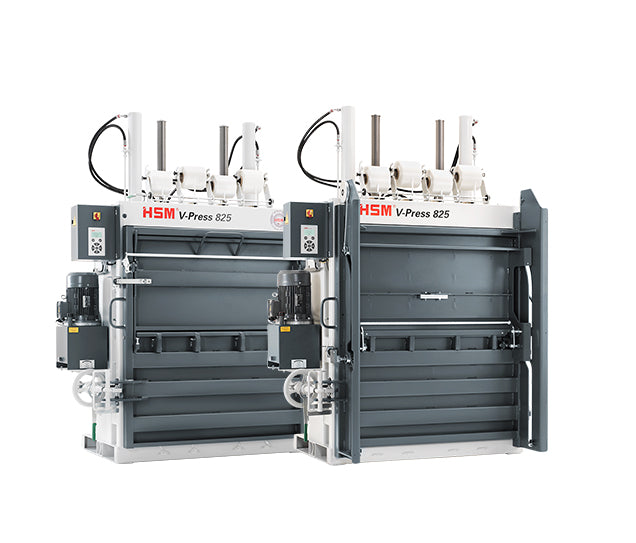
Before you specify
Frequently Asked Questions
What exactly does pro add over the standard 825 plus?
On HSM's published figures: a 10 mm taller loading aperture (540 mm vs 530 mm), 202 mm more depth, and 140 kg more machine weight at 1210 kg. Pressing force, bale size, maximum bale weight, drive power and overall height are identical. HSM does not publish a feature-by-feature explanation of the difference, so if it matters to your purchase, ask us to confirm it with HSM rather than relying on the name.
Will it fit under a low ceiling?
This is the strongest reason to choose the 825 family. At 2370 mm overall the pro is 129 mm lower than the V-Press 820 plus and 615 mm lower than the V-Press 1160. It will go into most standard commercial units with clearance to spare, where the 1160 usually will not. Still measure to the lowest obstruction, sprinkler heads and lighting included, rather than to the roof deck.
How dense is a 280 kg bale compared with the 820 plus?
Meaningfully denser. The 825 pro presses 250 kN into a chamber 700 mm high rather than the 820's 1000 mm, so the same 1200 x 780 mm bale face carries 280 kg instead of 250 kg in a physically smaller package. Denser bales stack better, store in less space and are cheaper per tonne to transport, which is the practical argument for the 825 over the 820.
What does it use for strapping?
Four-fold polyester tape, the same as the rest of HSM's 8-series presses. Tape is inexpensive, stores on a roll, needs no crimping tool and is safe to handle. Only the larger V-Press 1160 uses wire as standard, because a 550 kg bale springs back with enough force that tape is no longer the right answer. Tape is a consumable and is not supplied with the machine.
Does it need three-phase power?
Yes. 480 V three-phase at 60 Hz, driving a 4.8 kW motor, hard-wired before delivery. HSM lists the equivalent 400 V / 50 Hz European article at 4 kW, which is the same motor at a lower frequency rather than a smaller one. There is no single-phase version of this press, so confirm the supply during the site survey.