KOBRA
Kobra SSD (Solid State Devices)
Kobra SSD (Solid State Devices)
Product listing details
- Vendor
- KOBRA
- Product type
- Solid State Drive Shredder
- Condition
- New
- SKU
- Kobra SSD (Solid State Devices)
- GTIN
- 8026064999380
- Price
- $69,994.00 USD
- Currency
- USD
- Availability
- In stock
- Shipping policy
- Click to view policy
- Refund policy
- Click to view policy
- Return policy
- Click to view policy
🚚 Free Shipping Across the USA
Couldn't load pickup availability
Description
Description
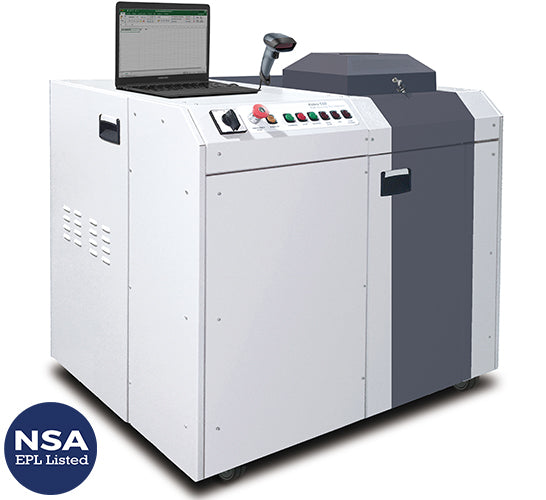
Kobra SSD is a Solid State Drive device shredder capable of destroying Solid State Drives, SIM Cards, Flash Drives, Circuit Boards, Enterprise Drives, Cell Phones, Tablets, USB Pen Drives, USB memory devices, flash memory, IC chips, CPU chips with internal ROM and/or flash memory, CD/DVD/Blu-ray disks**.
Kobra SSD meets and exceeds NSA/EPL 9-12 requirements for the destruction of solid state devices. Shredded material is reduced to sand-like particles. Kobra SSD has been approved by NSA and meets the requirements of NSA/CSS Specifications for Solid State Devices Destruction.
Kobra SSD is equipped with an active 1200 Watt internal state-of-the-art air filtration system to insure a clean, safe and comfortable operating environment. The air filtration system is in two stages. One active motorized stage for airborne particle matter and one complete motorized HEPA stage. Many chemicals and hazardous material are used in the manufacturing of ICs. Compared to machines with passive filters, active air filtration system in the Kobra SSD is the better way to protect the operator and the environment.
Easy access 240x25 mm feed port is equipped with a safety brush covering the complete opening for safety and ease of feed operation. Lockable feed hopper cover prevents unauthorized access to the contents of the hopper once material is fed into the machine.
Product Specification
Product Specification
Product Resources
Product Resources