


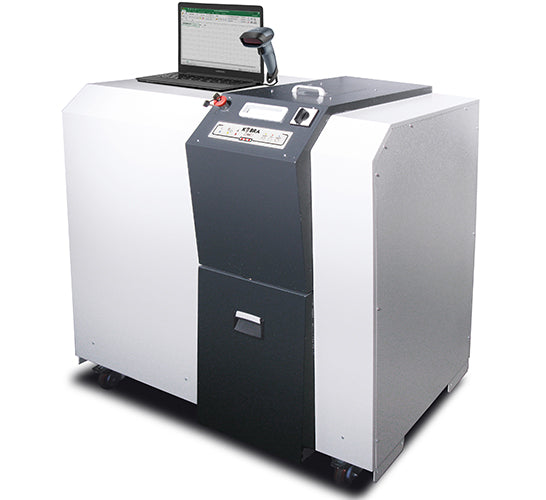
Before you specify
Frequently Asked Questions
Does shredding to H-3 actually destroy the data on a hard drive?
For conventional spinning hard drives, yes in any practical sense: the platters are broken into 40 mm fragments and the drive cannot be read by ordinary or commercial recovery means. H-3 is the DIN 66399 level for magnetic data carriers rather than a paper level. Whether H-3 satisfies your obligations depends on your own policy and, in regulated or classified environments, on the standard your regulator names.
Can it destroy SSDs to a defensible standard?
It will physically destroy them — SSDs are on Kobra's material list for this machine — but understand what you get. At 40 mm fragment size, individual memory chips on an SSD circuit board can survive intact, and standards for solid state destruction generally demand far smaller particles. If SSDs are a meaningful part of your estate, use a disintegrator such as the Kobra SSD rather than relying on an H-3 drive shredder.
Is it NSA approved?
We have not verified an NSA/CSS Evaluated Products List entry for this model and Kobra's own product page makes no NSA claim for it. Treat it as a commercial H-3 drive shredder. If your requirement is destruction of US classified storage media, specify equipment you have confirmed against the current NSA/CSS EPL, and do not accept a DIN rating as a substitute for that listing.
What will it physically accept?
Anything that fits the 127 x 30 mm (5 x 1.2 in) throat: 3.5 in and 2.5 in hard drives, solid state drives, LTO and Ultrium cartridges, optical discs, credit and identity cards, USB sticks, phones and PDAs. Whole servers, drive caddies with rails still attached and rack hardware are not in scope — strip drives from their carriers first, both to fit the throat and to keep steel rails away from the knives.
How often does the 11 gallon container need emptying?
Frequently on a busy run. Forty litres does not hold many drives' worth of metal fragments, and the debris is dense and heavy rather than bulky. Plan on emptying it several times during a session at anything approaching 250 drives an hour, and treat the full container as a heavy lift. The output is a metal waste stream and should go to a recycler that accepts shredded electronics.
What power supply and floor does it need?
208 V three-phase at up to 20 amps for US and Canadian installations, driving a 3 kW motor. It occupies 47.2 x 33 in and weighs about 1,250 lb, so check floor loading and, if it is going above ground level, the lift capacity. It is a permanent installation rather than something that gets wheeled between offices.
Is it loud enough to need a dedicated room?
Kobra rates it at 55 dB(A) on the US listing and 50 dB(A) on the EU datasheet, both of which are modest — quieter than most industrial paper shredders. The reason it usually ends up in a dedicated room is not noise but security: drives awaiting destruction are still live data, and the room needs the same access control as the storage they came from.