


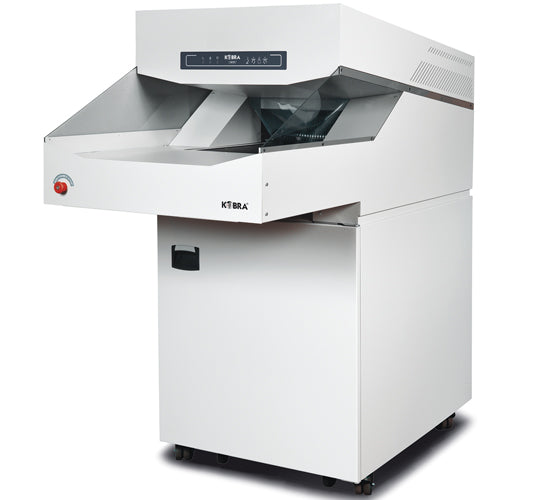
Before you specify
Frequently Asked Questions
Why is a 5.8 x 50 mm cut only P-3?
Because DIN 66399 grades on particle area. 5.8 x 50 mm is 290 mm², which fits under the 320 mm² ceiling for P-3 but is far above the 160 mm² limit for P-4. The cut looks small in the hand, and that misleads people. If your policy names P-4 or P-5, this machine does not satisfy it regardless of how fine the output appears.
How much faster is it than the C2 version?
About twice as fast on paper: up to 300 kg/hour against roughly 150 kg/hour for the P-5 C2, and 100 to 105 sheets per pass at 80 g/m² against 50 to 55. Everything else — motor, belt, cabinet, oiler, footprint, electrical supply — is identical. The whole difference between the two machines is the cutting head and the security level it produces.
What three-phase supply does it need?
208 V, three phase, 60 Hz at up to 30 amps per phase in the US configuration. Confirm you have that at the intended machine position before ordering; three-phase provisioning is the most common cause of delayed commissioning on industrial shredders. The EU version of the same machine runs on 380–415 V three phase, so check you have been quoted the correct regional model.
Will the bag last a full shift at 660 lb per hour?
No. At full rate you are putting several hundred pounds of paper an hour into a 470 litre chamber, and P-3 waste is bulky rather than dense. Expect frequent bag changes on a hard-running shift, and plan the split configuration with two 235 litre bags so a single operator can handle them. Bag handling, not motor capacity, is what sets real-world throughput on this machine.
Can it shred cardboard boxes?
Kobra lists cardboard as an accepted material, so incidental corrugate is within specification. Continuous box destruction is a different job: flattened double-wall board is hard on a document cutting head and fills the waste chamber very fast. If box volume is the reason you are looking at this machine, the Kobra Flexpack converts boxes into packing material, and the Cyclone with a coarse screen handles cardboard as designed material rather than as an exception.
Does the touch screen do anything beyond start and stop?
It drives the belt, reverse and the oiling cycle, and it reports faults such as an open door, a full bag or an overload, stopping the machine automatically in each case. The practical benefit is diagnostic: instead of an operator guessing why a machine has stopped, the panel states the reason, which shortens downtime on a machine that several people share across shifts.