


Before you specify
Frequently Asked Questions
Is P-3 enough for commercial document destruction contracts?
In most cases yes - P-3 is the level the majority of commercial records-destruction contracts and service agreements specify, and DIN 66399 defines it as appropriate for confidential internal data where unauthorised disclosure would have a considerable effect. It is not the right level for regulated personal data under a policy that names P-4 or P-5, and it is nowhere near sufficient for classified material. Read the contract you are servicing before assuming P-3 clears it.
How does this compare with the 10 x 70 mm version of the 16.50?
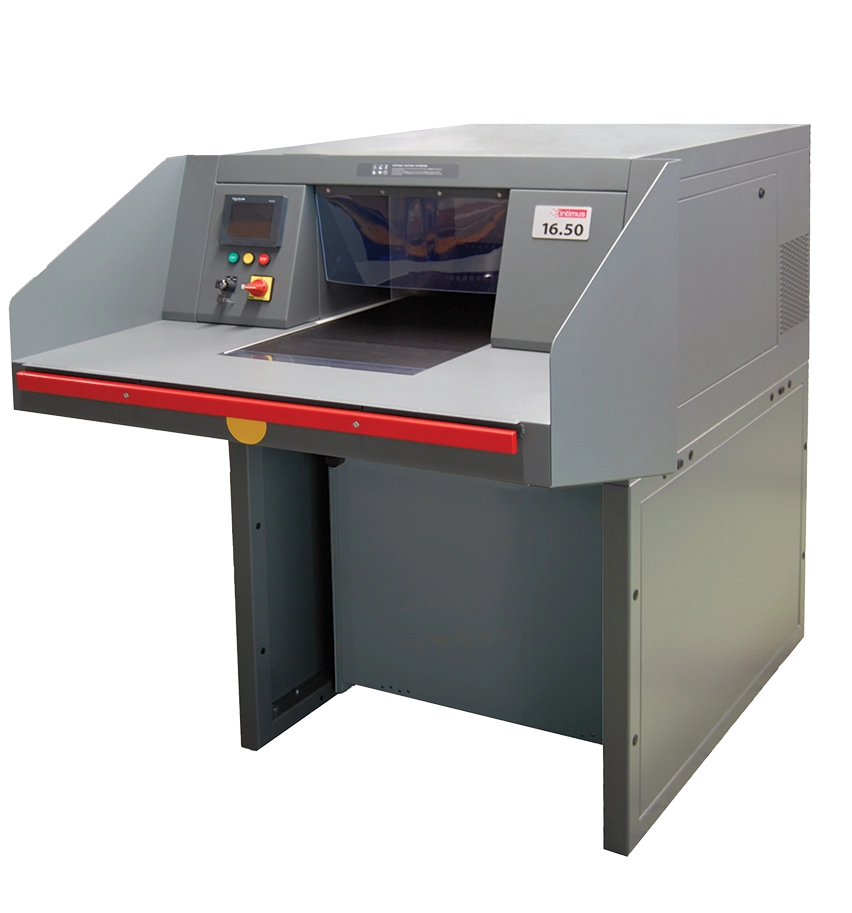
Same machine, different cutting head. This SKU cuts 6 x 50 mm at DIN P-3 and takes up to 330 sheets per pass at up to 1,050 lb per hour. The 655144 cuts 10 x 70 mm - 700 mm2, which puts it at P-2 - and intimus quotes up to 550 sheets per pass for it. The coarser head moves more paper; the finer head meets a higher standard. Choose on what your contracts and policies require, not on throughput alone.
Can it really take ring binders and bound documents?
Yes. intimus lists bound documents and ring binders among the materials the 16.50 handles, alongside paper, credit cards, ID badges, optical media and floppy disks. This is a meaningful operational advantage: on smaller machines, stripping binders and removing covers is often the single biggest labour item in a destruction workflow. It does not mean the machine is indifferent to what goes in - heavy metal beyond binder mechanisms will still damage cutters.
What supply and siting does the 16.50 need?
220 V, three-phase, 60 Hz for a 10 HP motor, and a footprint of 77 x 48 x 61 in plus clearance to load the conveyor and service the machine. There is no single-phase option. Because it arrives by freight and cannot be manoeuvred like an office cabinet, confirm the delivery route, door widths and floor loading before ordering. If your building has no three-phase service, budget for that work first - it commonly exceeds expectations.
Do I need the dust extraction option?
If the machine runs for extended periods in a space people occupy, yes, specify the APU100. High-volume paper destruction generates fine airborne dust that settles on everything nearby and is an irritant to operators. If the 16.50 is going into a dedicated destruction bay that is separately ventilated and lightly staffed, you can reasonably run without it. It is priced as an option rather than bundled, so decide before ordering rather than retrofitting.
How is waste collected, and what bags does it take?
Waste drops into a collection chamber of roughly 120 US gallons (about 454 litres) with a bin-full alarm and automatic shutoff so it cannot pack solid. intimus supplies PB7 waste bags for this machine, sold in packs as a consumable rather than included with the shredder. At full throughput the chamber fills quickly, so plan bag stock and a handling route for full bags as part of the installation rather than afterwards.
Does the automatic oiler mean no maintenance?
No, it means the most critical routine task is handled for you. The integrated oiler lubricates the cutting cylinders automatically, which protects the intimus industrial warranty - that policy states cross-cut machines require lubrication per the operator's manual and that failure to do so may void coverage. You still need to keep the oil reservoir filled, clear dust, inspect the conveyor and follow intimus's service schedule. An industrial shredder rewards a planned maintenance regime.
What warranty applies?
intimus North America covers industrial shredders with one year parts, 90 days labour and three years on the cutting cylinders. The cutting-cylinder term is the one that matters on a machine at this price, because cylinders are the expensive wear item. The coverage is conditional on lubrication being performed in accordance with the operator's manual, which is a further argument for the integrated automatic oiler doing that job rather than an operator.