


Before you specify
Frequently Asked Questions
What does H-3 mean and is it enough for our drives?
H is the ISO/IEC 21964 (DIN 66399) protection class specifically for hard disk drives, and H-3 is achieved here through a 30 mm blade cut. For most commercial and public-sector policies covering retired storage, H-3 combined with documented destruction is accepted. Policies for classified material are a separate regime with their own requirements - check the governing standard for your environment rather than assuming a DIN class satisfies it.
Can it destroy SSDs as well as spinning disks?
Yes. The machine has a separate 135 mm SSD intake and uses 12 mm blades for electronic media, giving E-2 for that class. Whether E-2 is sufficient depends on your policy. If you need finer solid-state destruction, the intimus SSD Granulator reaches E-4 with a 5 mm screen and E-5 with a 3.5 mm screen. Many operations run a Gladiator for HDDs and a Granulator or FlashEx for flash media rather than trying to do everything on one machine.
How many drives can one operator realistically get through in a shift?
The published rates are up to 150 3.5 in drives per hour and up to 400 2.5 in drives per hour. Those are machine rates. In a real decommissioning workflow, serial-number capture, pulling drives from caddies and emptying the 120-litre bin all take time, and the bin fills quickly because drive debris is heavy. Budget realistically at well under the headline rate over a full shift.
Does it destroy printed circuit boards?
Yes - PCBs are on the intimus approved materials list for this machine, which is worth noting because many drive shredders are not rated for them. That matters if your destruction policy covers controller cards, RAID modules or embedded storage on system boards rather than just the drives themselves. Feed boards individually rather than mixed into a batch of drives.
What does it weigh and what does the site need?
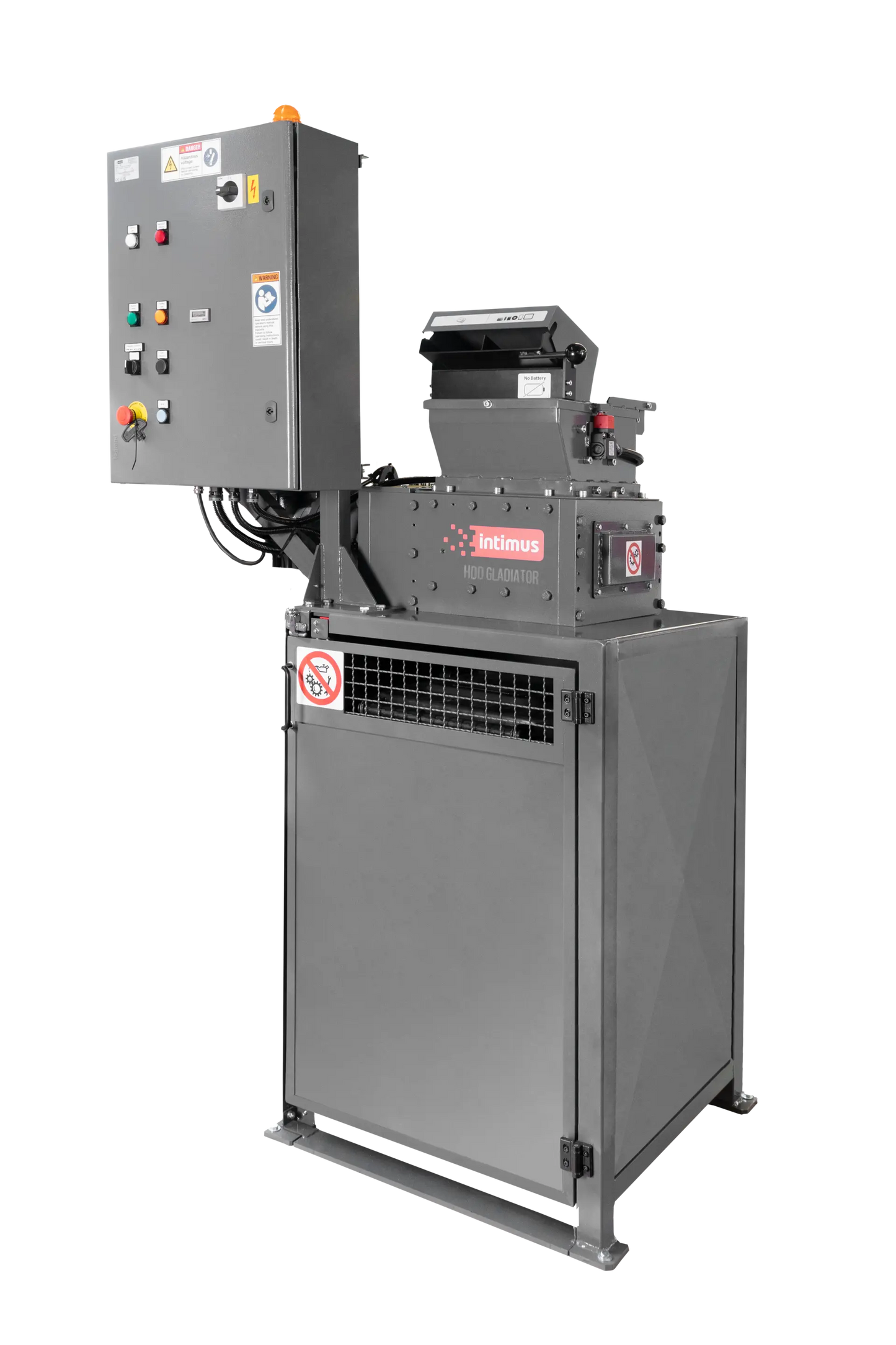
540 kg, in a cabinet 104 cm wide, 84 cm deep and 168 cm tall. That is a permanent installation. Check floor loading - particularly on a raised access floor in a data centre - and check the delivery route, lift capacity and door widths before ordering. It also needs a three-phase supply; the European datasheet specifies 400 V / 50 Hz and we would ask you to confirm the North American requirement with us before scheduling installation.
Are batteries a problem?
Yes, and they must be removed. Smartphones and tablets are approved materials only with the battery removed. A lithium cell crushed inside a machine containing shredded metal and plastic is a real fire hazard, not a theoretical one. Make battery removal a documented step in your process. Hard drives themselves contain no battery, so this applies to handsets, tablets and any device with an internal cell.
What warranty applies?
intimus North America covers hard drive shredders for two years on parts and 90 days on labour, with labour cover available in the continental US only. Normal wear items and electrical components - cutters, gears, belts, chains, PC boards and optics - are excluded unless found to be defective. Given the duty cycle of a machine like this, treat blade wear and scheduled maintenance as an operating cost.