


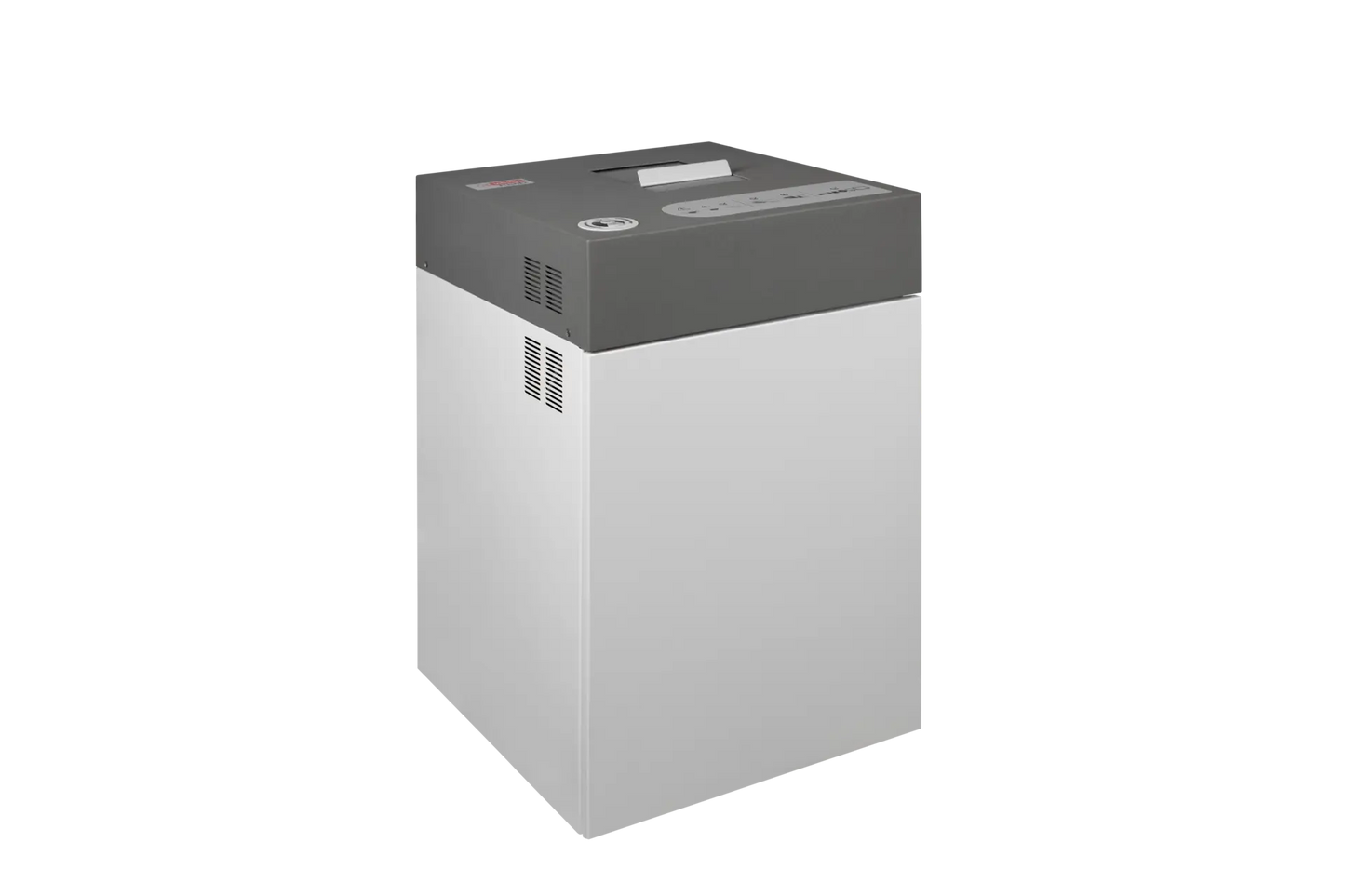
Before you specify
Frequently Asked Questions
Can the FlashEx destroy hard disk drives?
No. It is specified for flash media, optical discs, cards and handsets - SSDs, USB sticks, SD cards, smartphones, tablets, floppy disks, CDs, DVDs and Blu-rays. Conventional spinning 3.5 in and 2.5 in hard drives are not on that list. For HDDs use the intimus HDD Gladiator, which is built for them with 30 mm blades and rated H-3, and which also handles SSDs and data tape. Putting an HDD through a FlashEx risks the cutting head.
Do I have to remove batteries from phones and tablets?
Yes, without exception, and intimus states this explicitly in the approved materials list. A lithium cell that is punctured or crushed can ignite, and the fire risk inside a machine full of shredded plastic and metal is serious. Remove and dispose of batteries through your normal battery waste route before destruction. Build this into your process rather than relying on whoever happens to be operating the machine.
What does E-3 actually mean, and is it enough?
E-3 is a level on the ISO/IEC 21964 (DIN 66399) scale for electronic data carriers, and the FlashEx achieves it with a 4 x 15 mm particle. For the large majority of commercial data-protection policies covering retired corporate media, E-3 is accepted. If your policy or your customer contract names E-4 or E-5, the FlashEx does not reach those - the intimus SSD Granulator does, with 5 mm and 3.5 mm sizing screens giving E-4 and E-5 respectively.
How long does a batch of 200 laptop SSDs take?
At the published rate of up to 1,000 plastic-cased 2.5 in SSDs per hour, the cutting head is not the limiting factor - 200 drives is well under an hour of machine time. In practice the time goes on removing drives from chassis, recording serial numbers and emptying the 25-litre bin, which fills faster than its size suggests because destroyed flash media is dense. Plan the process, not just the machine time.
Why is the bin only 25 litres?
Because electronic media waste is heavy rather than bulky. A 25-litre bin of shredded SSD and phone material weighs considerably more than the same volume of shredded paper, and a larger bin would be difficult to lift safely. Expect to empty it more often than the litre figure implies, and treat the waste as electronic scrap for recycling rather than general waste.
Can I put paper or CDs through it at the same time?
CDs, DVDs and Blu-rays are approved and can be destroyed on this machine at up to 1,800 discs per hour. Paper is not on the approved list and should not be fed through it - the cutting geometry is designed for rigid media and paper will not be destroyed to a paper security level in any case. Keep document destruction on a paper shredder such as the intimus 60 series.
What electrical supply does it need in the US?
The intimus datasheet gives 230 V / 50 Hz, which is the European configuration, and we have not been able to verify the North American specification from published documentation. Rather than print a figure we cannot substantiate, we would ask you to contact us before ordering so we can confirm the voltage, frequency and current draw for the unit that will actually be shipped to you.